Saint Munditia
The saint.The skeleton.The inspiration.
Saint Munditia is the historical inspiration behind Spinster Day.
Who She Was
Munditia was an early Christian martyr of Rome. Almost nothing is known of her life. Her remains come from the Roman catacombs, and tradition holds that she died for her faith around the year 310.
November 17
Her grave inscription gives November 17 as the day of her death. It is kept as her feast day — and it is the day Spinster Day is celebrated.
Munich
Her relics were brought from Rome to Munich in the seventeenth century and have rested since 1677 in St. Peter’s Church — the Alter Peter, the city’s oldest parish church.
The Jeweled Reliquary
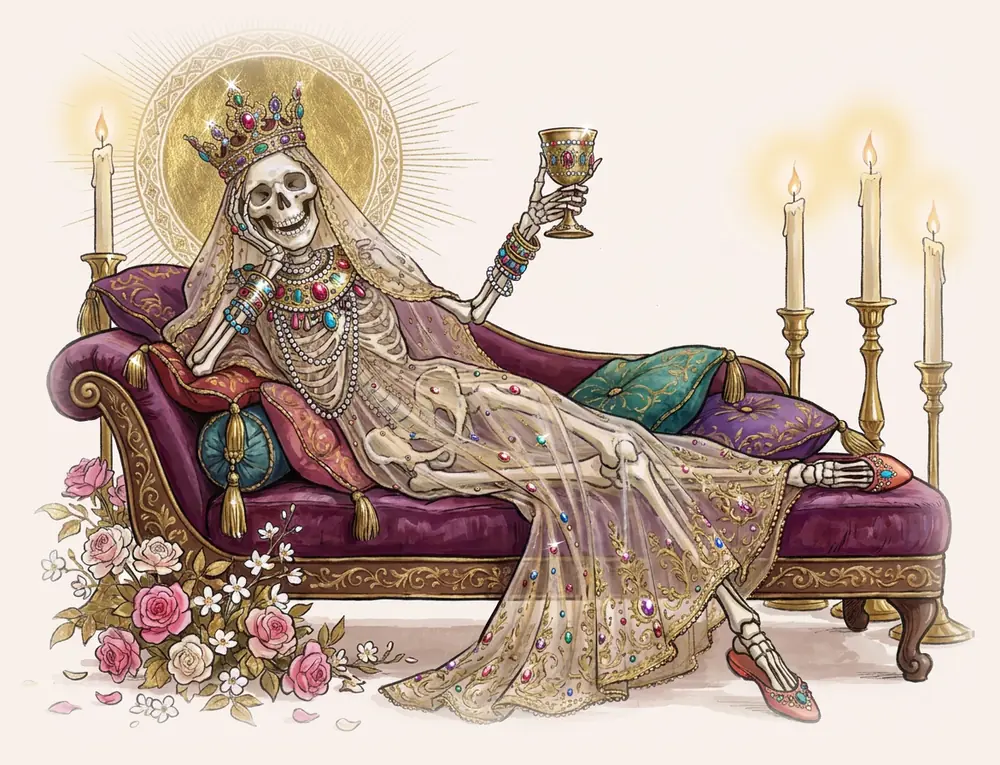
She lies in a glass shrine on a side altar: a gilded skeleton set with coloured stones, veiled in fine netting and holding a small glass vessel.
Why She Inspired Spinster Day
Saint Munditia is venerated as the patron saint of unmarried women. Spinster Day borrows her day and her splendour to honour women who belong to themselves.
Spinster Day is an independent celebration inspired by Saint Munditia. It is not affiliated with, or endorsed by, the Catholic Church or St. Peter’s Church, Munich.
Learn moreSt. Peter’s Church, Munich